
Modular live-fire training infrastructure for defence and law enforcement.
Four module types combine into one fully autonomous facility, sized to the training you need.

Every part of the range is a module.
Modules are built on one standard unit size, with the entrance module spanning two units. On site they are joined in sequence, from the entrance module where users arrive to the bullet trap at the end of the range.
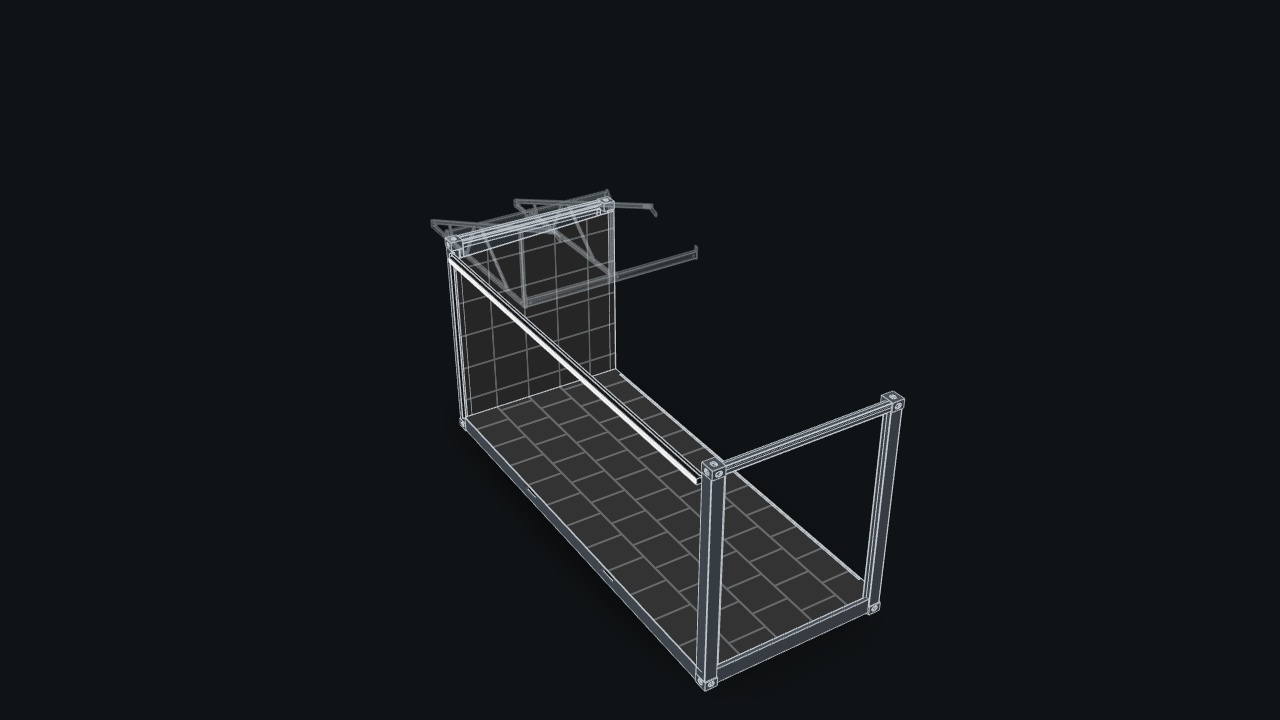
Entrance module
Entry, lockers and storage
A double-length module. Access control at the outward-opening door on its short end, then lockers, general storage and space to get ready before the range.
Range module
The firing hall
Repeatable range segments with lanes and targets. Add segments to extend the range.
Bullet trap module
Projectile capture
Closes the range and captures and contains projectiles at the end of every lane.
Technical module
Systems and air
Houses the ventilation, power and control systems, including the patent-pending laminar ventilation. Sits behind the bullet trap at the end of the line, with the ventilation on its rear face.
Longer range, more range modules.
The entrance, bullet trap and technical modules stay the same. Range length is set by how many range modules sit between them, so the facility can be specified to the need and extended later.
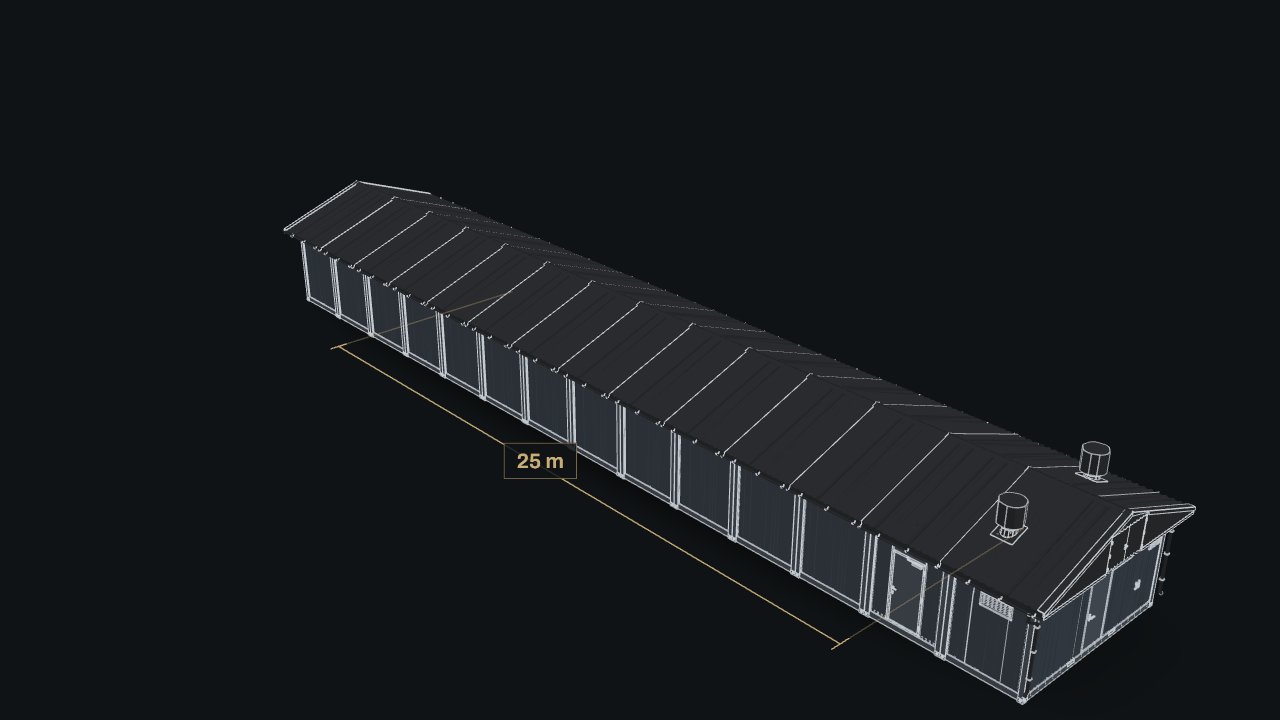
5 lanes, 15 m range
5 lanes, 25 m range
5 lanes, 50 m range
Laminar ventilation.
Clean air at the firing line
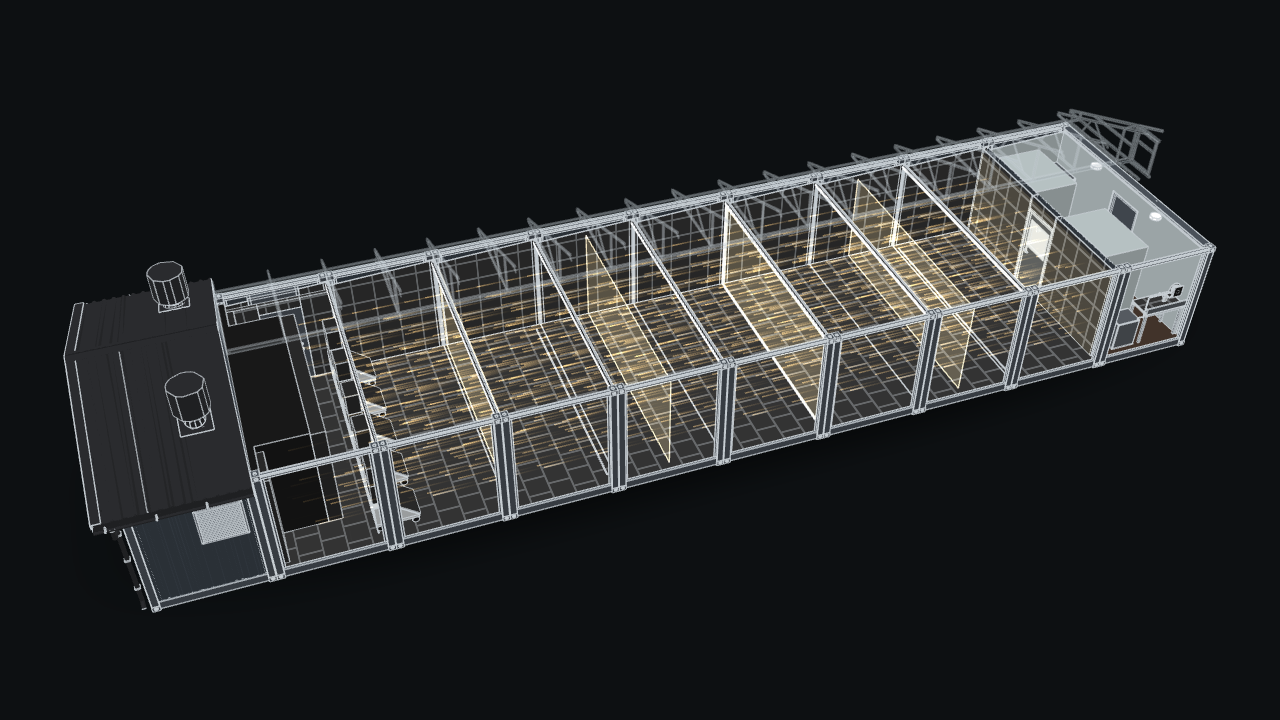
A patent-pending laminar ventilation system, housed in the technical module, keeps the air at the firing line clean and controlled. Air moves evenly at 0.5 m/s from behind the firing line towards the bullet trap, carrying smoke and lead particles away from the shooter.
A range that monitors itself.
Sensors throughout the modules track the range’s condition, so problems are found before they stop training.
Autonomous operation
The range is designed to operate without permanent staff on site, so it is available when units need to train. Sessions are booked in advance. The entrance opens for the booked time only when the range is ready — ventilation running, doors closed, no active alarms — and every session is logged. The range can be followed and stopped remotely by a supervisor.
Predictive maintenance
The range knows when maintenance is needed before it is needed, so service is planned ahead instead of waiting for a breakdown.
Air quality analysis
Sensors continuously analyse the air in the range, so the air quality shooters are breathing is measured, not assumed.
Shot logging
Shots fired are logged, giving a record of how the range is used. The log is read on the range's own dashboard or through the FOB service: it shows use per session, forecasts bullet-trap and filter maintenance from the shot count, and supports the range permit's annual shot count and the users' exposure records.
For forces that train every day.
Defence
A shooting range that can be placed where the unit is, instead of moving the unit to the range. A garrison, training centre or deployed base gets a range of its own for qualification shooting, drills and weapon familiarisation, without transport time — and the range moves with the unit when needed.
Law enforcement
Regular qualification and training close to where officers work. A police department places the range on its own premises or shares one between stations, so officers qualify and train on duty time, with air-quality and shot records that support occupational health and safety.
Contact us
Questions about FOB, pricing or a configuration for your organisation? Send us a message and we will get back to you.
Behind FOB is a team with more than 20 years of combined experience in defence technology and training.